Robust Corporate Governance and the Corporate Sustainable Development Committee
Corporate Governance Overview
Since its establishment, the Company’s vision has been“STRIVE FOR EXCELLENCE;BECOME A WORLD LEADING BRAND IN "GREEN" LAMINATE MATERIAL” and it has taken“RESPONSIBILITY, TEAMWORK, VALUE CREATION”as its core values. EMC is committed to continuous technological innovation and improvement to create more value for the world.
|
Material Topic |
Business Performance |
|
|
Policy Commitment |
Continue to innovate and expand the business; introduce new products to meet the needs for the development of electronic product applications so as to stabilize profit growth and maintain sustainable operations. |
|
|
Sustainability Indicator |
2024 Targets and Performance |
Short-term, Medium-term, and Long-term Goals |
|
Diversified Board structure |
Currently, the Board composition is 87% male (7 directors) and 13% female (1 director) |
Increase the proportion of female directors to 25% |
|
Corporate governance evaluation indicator |
Ranked among the top 6–20% of companies in the corporate governance evaluation |
Rank among the top 5% of companies in the corporate governance evaluation |
|
EMC was listed as a constituent of the FTSE4Good TIP Taiwan ESG Index in 2024 |
Continuously listed as a constituent of the FTSE4Good TIP Taiwan ESG Index |
|
|
Continuous record of operating performance |
The 2024 annual revenue reached a record high of NT$64,376.727 million, representing a year on year increase of 55.89% |
Enhance competitiveness by expanding overseas markets Develop diversified products and sales channels |
|
Material Topic |
Business Ethics and Ethical Management |
|
|
Policy Commitment |
EMC fully understands the importance of integrity in business operations and adheres to the relevant concepts, including formulating and compliance with the Code of Ethics, internal control, insider trading, intellectual property management, and personal data protection, as well as strict prohibitions on corruption and competitive behavior |
|
|
Sustainability Indicator |
2024 Targets and Performance |
Short-term, Medium-term, and Long-term Goals |
|
Compliance with ethical management |
In 2024, there were no incidents of illegal behavior or corruption violating the principle of integrity. All EMC employees complied with ethics-related laws and regulations to implement ethical management |
Zero incidents of illegal behavior or corruption violating the principle of integrity |
|
Awareness raising on ethical management |
Internal and external educational training activities related to ethical management issues were conducted in 2024 (including ChatGPT and Generative AI: Applications and Challenges, advocacy of corporate social responsibility policies, promotion of training for the Corporate Social Responsibility Development Advocacy Taskforce, corporate ethical management policy advocacy, and other related courses). A total of 1,297 hours of training were conducted at plants in Taiwan. On average, each employee received 0.56 hours of training |
New recruit training completion rate and employee education and training coverage rate reached 100% |
|
Material Topic |
Customer Privacy and Information Security |
|
|
Policy Commitment |
Maintain a safe and secure environment for the Company’s information systems, protect the Company’s trade secrets, and prevent misuse, leakage, tampering, and destruction of the Company’s information system and data. Continue to maintain the Company’s competitive advantages and gain customers’ trust to achieve the main goal of sustainable operation |
|
|
Sustainability Indicator |
2024 Targets and Performance |
Short-term, Medium-term, and Long-term Goals |
|
Information security |
A total of four recovery drills were conducted in 2024 at EMC, Elite Electronic Material (Kunshan) Co., Ltd., Elite Electronic Material (Zhongshan) Co., Ltd., and Elite Electronic Material (Huangshi) Co., Ltd., focusing on the inter-plant switching of major equipment and services and testing of backup data recovery |
No violation of information security related laws and regulations; no information security incidents |
|
Introduced ISO 27001:2022 Information Security Management System and obtained third-party certification. |
1. Protect all forms of information, including paper, cloud, and digital information, through P-D-C-A management system procedures 2. Improve resistance against cyberattacks and provide a centralized management framework to protect all information under the same architecture 3. Ensure organization-wide protection, including against technology-based risks and other threats, and respond to evolving security threats 4. Reduce costs and expenditures associated with ineffective protective technologies |
|
n Corporate Organizational Structure
The Board of Directors is EMC’s highest governance body and the decision-making center for material business affairs. To continuously strengthen corporate governance, independent directors have been installed within the Board of Directors. Additionally, functional committees such as the Remuneration Committee, the Audit Committee, and Corporate Sustainable Development Committee have been established to develop comprehensive performance objectives and a remuneration structure for the Company’s directors and managers and to effectively implement operations such as internal control, risk management, And improve the sustainable management of enterprises, etc. to respond to various potential corporate risks.
For information regarding the corporate governance organizational structure and affiliated enterprises, please refer to the relevant descriptions under Corporate Governance / Organizational Structure.
n Operation of Board of Directors
EMC has established its Board of Directors, Remuneration Committee, Audit Committee, and Corporate Sustainable Development Committee in accordance with the Company Act and the Securities and Exchange Act. Directors and committee members are elected from among candidates nominated in accordance with Article 192-1 of the Company Act as stipulated in the Regulations on Director Election (any shareholder who holds 1% or more of the total number of outstanding shares issued by the Company and is competent in sustainability impact management and future planning) and all have long years of experience serving important managerial positions such as chairman, president, etc. at TWSE/TPEx-listed companies in industries related to technology, biochemistry, food, and manufacturing. They are all experts in marketing, technology, and business management who possess rich industrial knowledge and a keen business sense. When selecting Board members, in addition to considering the candidates’ professional backgrounds and independence, the candidates’ ability to manage material impacts on the organization such as industry development trends, risk management, climate change, information security governance, and other critical issues is also evaluated. Board members’ duties include establishing a good Board governance system; supervising, appointing, and guiding the Company’s managerial personnel; strengthening management functions; and being responsible for the Company’s overall economic, social, and environmental operations to maximize stakeholders’ interests and make the best decisions to achieve EMC's sustainable development.
The Board of Directors serves as the EMC’s highest governance body, and serves a 3-year term. The Chairman of the Board serves as the meeting chair and leads the Board of Directors in implementing and supervising the Company’s various operations. The following measures have been taken by the Company:
1. More than 50% of the Board members do not concurrently serve as managers or employees of the Company.
2. The Company’s Board includes four independent directors, accounting for 1/2 of all directors. The independent directors possess extensive experience in areas of finance and accounting, business management, and legal affairs, respectively, and they effectively utilize their professional competencies to supervise the Company’s operations.
3. All members of the Company’s Audit Committee and Remuneration Committee are independent directors.
Six meetings were convened by the Board in 2024 to review and supervise the Company’s material decisions regarding economic, social, and environmental issues to maximize benefit and interests for shareholders. The sustainability performance is reported to the Board of Directors once per year. In cases where meeting items involve the interests of specific directors or the corporations they represent, the critical details of the involved interests must be explained at that Board meeting. If there is any concern that the Company’s interests might be affected, the directors in question shall not be allowed to join the discussions and voting, and shall recuse themselves to avoid conflicts of interest. Moreover, they cannot act on behalf of other directors to exercise their voting rights. For details on the Board members’ shareholdings and their positions on other boards of directors, please refer to page. 4–7 of the 2024 Annual Report. Board members have no cross-shareholdings, transactions, or outstanding balances with stakeholders.
In accordance with the requirements of the Taiwan Stock Exchange Corporation Procedures for Verification and Disclosure of Material Information of Companies with Listed Securities, EMC shall communicate with and report to the Board of Directors when the following situations, which are regarded as material critical events, occur: Occurrence of a disaster, mass protest, strike, environmental pollution, cyber security event, or any other material event, resulting in any of the following situations:
1. Where the company incurs a material loss or impact;
2. Where a relevant authority orders the suspension of work, suspension of business, termination of business, or revokes or voids a permit pertaining to pollution;
3. Where the administrative fines for a single event have accumulated to NT$1 million or more.
No material critical events happened to EMC in 2024.
For information regarding the Board of Directors, please refer to Corporate Governance / Board of Directors; for information regarding the functional committees, please refer to Corporate Governance / Functional Committees .
Corporate Sustainable Development Committee (ESG Committee)
n Corporate Social Responsibility Governance and the Corporate Sustainable Development Committee
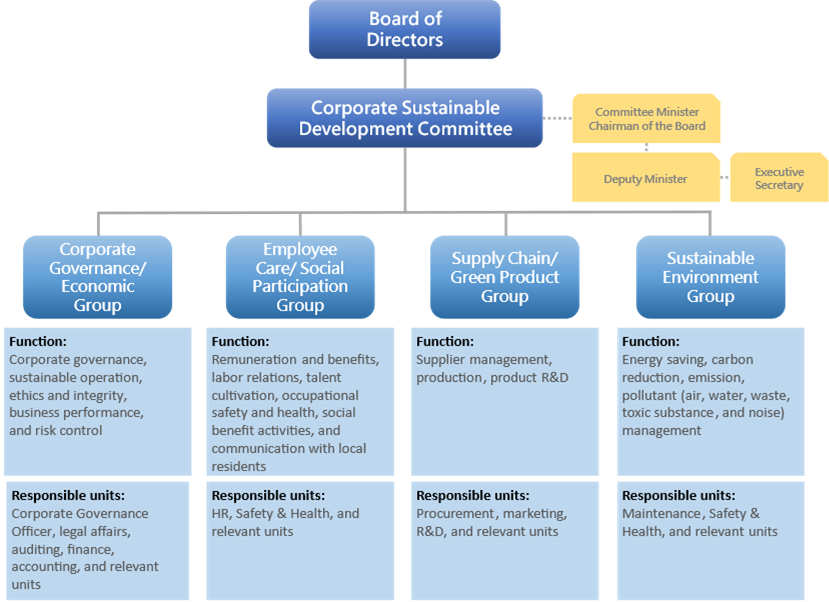
EMC is committed to fulfilling corporate social responsibility and carrying out the concept of sustainable management. To achieve these goals, the Board of Directors approved the CSR Code of Conduct. Additionally, in October 2024, the Board passed a resolution elevating the Corporate Sustainable Development Committee to a functional committee directly under its purview and formulated the Corporate Sustainable Development Committee Charter to regulate the committee’s purpose, composition, authority, and other related affairs. The Corporate Sustainable Development Committee is chaired by the Chairman and oversees four working groups, which are the Corporate Governance/Economic Group, the Supply Chain/Green Product Group, the Employee Care/Social Participation Group, and the Sustainable Environment Group. The groups are formed by heads of relevant units and departments or their representatives, and they are responsible for conducting the data collection, planning, assessment, and implementation for relevant issues. The Report’s information was collected by various departments and submitted to the Corporate Sustainable Development Committee after being reviewed and approved by department heads. The Committee compiled and edited the information, then conducted internal audits to confirm report content. The completed Report was released after being reviewed and approved by the Board of Directors.
The Committee’s major role is to guide the implementation directions of the following tasks based on the principles of corporate
sustainable development:
1. Implementing corporate governance
2. Developing a sustainable environment
3. Maintaining public benefits
4. Strengthening the disclosure of corporate sustainable development information
5. Controlling and managing the Company’s existing or potential risks
The Committee consists of at least three members, who must be approved and appointed by the Board of directors, and more than half of the members should be independent directors. At least one member should specialize in corporate sustainable development, and one member must be elected from among the members to serve as the committee convenor and meeting chair. The information of the founding members is listed in the table below. For details of the members’ professional competencies, please refer to the section titled “Board Diversity Policy and Implementation Status”.
【List of Corporate Sustainable Development Committee Members and Members’ Attendance】
|
Name |
Attendance Rate in 2024 (including proxy attendance) |
|
|
Chairman (Committee Chair) |
Ding-Yu Dong |
100% |
|
Independent Director |
Dui-Chien Cheng |
100% |
|
Independent Director |
Hsi-Chia Chen |
100% |
The first session of the first committee meeting was held on December 23, 2024 (Monday). The attendance rate (including proxy attendance) was 100%. The meeting content included discussion of EMC’s strategic corporate sustainability goals and short-, medium-, and long- term plans, as well as a report on the energy saving and carbon reduction projects implemented in 2024. The information was then reported at the 17th Board Meeting of the 12th term in December 2024.
|
Meeting Topics |
|
|
Dec. 23, 2024 |
• Report on the Company’s sustainable development plan for 2025. • Report on the Company’s energy saving and carbon reduction projects in 2024. |
The first session of the second Corporate Sustainable
Development Committee meeting was held on December 23, 2025 (Tuesday), with an
attendance rate of 100%. The meeting included discussion of the Company’s
sustainability performance for 2025, the sustainability development plan for
2026 (including carbon reduction targets and greenhouse gas inventory
planning), and the Company’s renewable energy procurement plan. The
aforementioned matters were subsequently reported at the 4th Board Meeting of
the 13th term in December 2025.
The First Session of the Second Corporate Sustainable
Development Committee (2025)
|
Date |
Meeting Agenda |
Discussion
Items |
|
Dec. 23, 2025 |
• Report on the
Company’s sustainability performance for 2025 and the sustainable development
plan for 2026. • The Company’s renewable energy procurement plan. |
• Sustainability
performance of ESG-related projects in 2025 • Proposed the Company’s renewable energy procurement
plan for discussion and approval by the Committee |
Corporate Social Responsibility Statement
|
l Implement corporate governance and strictly abide by business ethics. l Ensure that the management and operation of the organization meets government and international regulatory requirements, and is continuously improved. l Comply with social responsibility standards and relevant laws and regulations. l Provide employees with a safe and healthy working environment and reasonable remuneration and benefits. l Prevent pollution, reduce energy consumption, and conserve energy and resources. l Provide regular training to facilitate employee upskilling. l Encourage suppliers, stakeholders and other related parties to abide by these policies. l Conduct regular evaluations through internal/external audits to ensure the improvement and advancement of social responsibility practices. l Commit to avoiding the use of conflict metals (minerals). |
n Corporate Sustainable Development Committee Framework