Stakeholder Communication
Stakeholders’ demands are the key to an enterprise’s sustainability and success. EMC believes that communicating with stakeholders, understanding stakeholders’ needs and expectations, and responding accordingly will not only assist an enterprise in reviewing and planning short-, medium-, and long-term strategies but can also increase stakeholders’ appraisal of the enterprise, thus generating new business opportunities for sustainable operations.
By following the AA1000 Stakeholder Engagement Standard (AA 1000 SES), various departments of EMC identified the following key stakeholders: investors (shareholders and the Board of directors), governing agencies, customers, suppliers, and employees. The Company’s key stakeholders have not changed significantly relative to the 2023 Report. In addition, the status of stakeholder communication, including communication practices and achievements, should be reported to the Board of Directors once a year, with the latest report date being December 23, 2025.
|
Stakeholder |
Communication Channels |
Frequency |
Topics |
2025 Communication Practices and Achievements |
Purpose of Communication/ Engagement |
|
Investors (Shareholders) |
-Annual General Meeting (Shareholders’ Meeting)¤ |
Once a year |
-Corporate governance -Company business overview -Company financial overview -Information disclosure |
-Released 81 pieces of material information in both
Chinese and English. -Participated in 28 domestic investor briefings |
Maintaining stable financial performance is EMC’s commitment to all investors. |
|
-Publish quarterly/annual financial reports¤ |
Four times a year |
||||
|
-Inquiry from calls or email |
Irregularly |
||||
|
-Website¤ |
Irregularly |
||||
|
- Investor Conference |
Irregularly |
||||
|
Governing Agencies |
-Official documents ¤ -Respond to inquiries of
governing authorities -Conferences and seminars |
Irregularly |
-Regulation compliance -Policy implementation -Information disclosure |
-Participated in 3 legal and business advocacy meetings
held by TWSE in 2025. |
Legal compliance is
EMC’s highest guiding principle |
|
Customers |
-Website -Exclusive services |
-Irregularly -Permanent |
-Customer privacy protection -Customer satisfaction -Rights and interests |
-EMC conducts satisfaction surveys on major customers
or high volume customers every 6 months and improves service and product
quality based on survey feedback. -In 2025,
the Company completed customer satisfaction surveys for 12 clients. |
Enhance customer satisfaction and improve service and product quality. |
|
Suppliers |
-Written papers -Written audits -On-site audits |
Irregularly |
-Procurement policies and requirements -Supplier operational procedures |
-178 suppliers have signed the Supplier Social
Responsibility Commitment Statement, and the signing rate for major suppliers
has reached 100%. |
Work with suppliers to achieve sustainability. |
|
Employees |
-Websites -Official document/
announcement¤ -Email -Instruction manual -Labor-management
meetings -Two-way communication
meetings -Education and training |
Irregularly |
-Compensation and benefits -Career development -Labor relations -Education and training -Personnel recruitment -Working environment -Safety and health -Human rights |
-Nursing services are available at all plants, and
monthly onsite health consultations are provided by occupational health
specialists. -Maternal health protection programs are promoted, and
breastfeeding (lactation) rooms and associated health guidance and
consultation services are provided for pregnant or postnatal employees. -The Employee Mailbox is placed in employee canteens
within each plant, and it is checked every week for letters to be collected.
Employees can also send e-mails to hr-emc@mail.emctw.com. Senders’
identity information will be held in confidence. The Company is committed to
ensuring that all senders are protected from retaliation or other forms of
unfair treatment. Mail is replied to suggestions in writing or through other
means within 3 months of receipt, and carbon copies of the responses are sent
to the President’s Office. -No
substantiated complaints in 2025. |
Listen to employees through various communication platforms to create a happy workplace. |
|
Items marked with ¤are those involving the Board of directors. |
|||||
Material Topics Identification and Analysis
EMC has followed GRI standards and the four principles of Inclusivity, Materiality, Responsiveness, and Impact entailed in AA1000 AP (AA1000 Accountability Principles) to identify the material issues related to the Company’s operations. Moreover, by following GRI Standards 2021, EMC has further assessed the significance of the material issues’ impacts on the economy, the environment, and people (including human rights). The assessment results serve as the basis for the Company’s planning of sustainable development strategies as well as the foundation for the Report’s information disclosure.
|
Implementation Steps |
Content |
Result |
|
Step 1. Identify targets for communication |
The Stakeholder Identification Questionnaire was designed based on the five principles highlighted in AA1000 Stakeholder Engagement Standard (Dependency, Influence, Responsibility, Diverse Perspectives and Tension) and distributed to Corporate Sustainable Development Committee taskforce members. After the statistical results of the questionnaire were approved by the Corporate Sustainable Development Committee, five groups of stakeholders were confirmed based on their significance, namely, investors (shareholders and the Board of Directors), governing agencies, customers, suppliers, and employees. |
Major stakeholder groups |
|
Step 2. Compile sustainability issues |
References: 1. GRI sustainability reporting standards 2. Task Force on Climate-related Financial Disclosures (TCFD) framework 3. The United Nations SDGs: the 17 goals and 169 associated targets were assessed to screen for causes applicable to EMC 4. Sustainability Accounting Standards Board (SASB) Standards, and 5. Through the process of communication with stakeholders, the Corporate Sustainable Development Committee summarized and listed 37 sustainability issues. |
37 sustainability issues |
|
Step 3. Survey stakeholders’tension |
To identify the closely related and influential targets, the Corporate Sustainable Development Committee surveyed the tension of the five stakeholder groups’ concerns about the 37 sustainability issues using the 2024 EMC Stakeholder ESG Questionnaire. A total of 320 valid questionnaires were returned, including 290 from employees, 2 from shareholders/investors, 25 from suppliers, 1 from a governing agency, and 2 from other stakeholders. Based on these surveys, 20 issues with higher tension of concern were selected (8 environmental issues, 6 social issues, and 6 corporate governance issues) |
320 valid questionnaires collected |
|
Step 4. Determine material issues |
After examining the results obtained in Step 3 and making relevant adjustments based on the Corporate Sustainable Development Committee’s suggestions, the Corporate Sustainable Development Committee selected 20 high-tension issues and assigned scores based on the management team’s suggestions regarding each issue’s degree of impact and probability of occurrence. The Corporate Sustainable Development Committee eventually selected 14 issues as the current year’s material issues, and reported the result to the Board of directors. |
20 high-tension issues |
|
Step 5. Assess the significance of impact |
After Steps 1–4 were implemented and completed (during the period from November 2024 to February 2025), the Corporate Sustainable Development Committee further assessed the impacts of 14 material issues related to the economy, the environment, and people (including human rights) through an Impact Assessment Questionnaire, then gave scores to the positive/negative impacts and analyzed the material issues’ impact boundaries and levels of involvement in the value chain. Through this step, EMC confirmed that the 14 material issues all significantly impact the Company. |
14 material issues |
|
Step 6. Determine the sequence of issues and the content to be disclosed |
The Corporate Sustainable Development Committee determined the sequence of the material issues based on their impact intensity and described the material issues’ response strategies; short, medium, and long-term goals; performance achievements; and management guidelines in the Report in accordance with each issue’s reporting requirements. The 14 material issues correspond to 16 GRI topics in total. |
16 GRI topic standards |
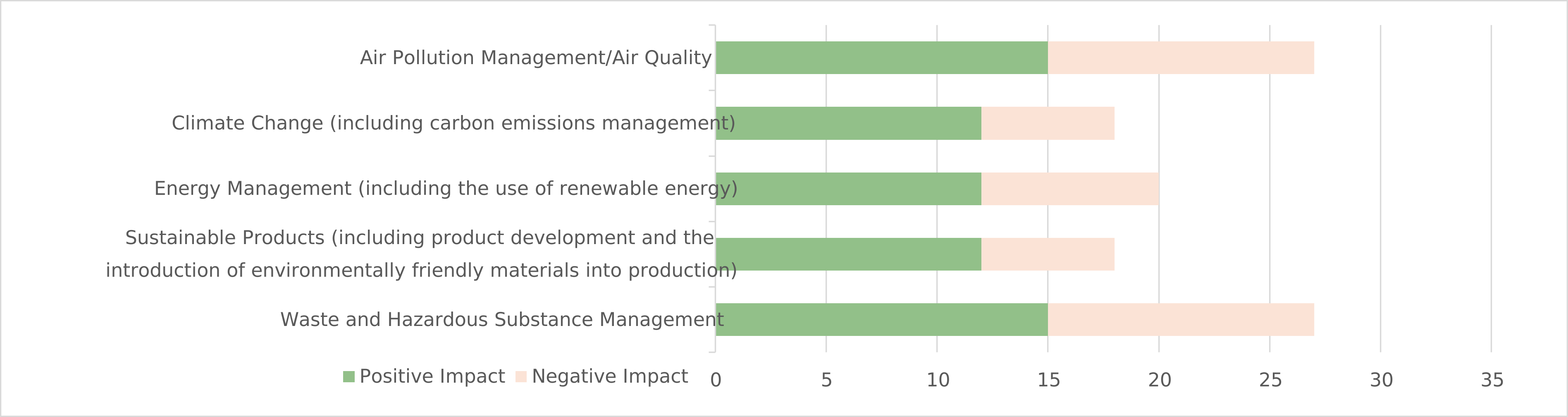
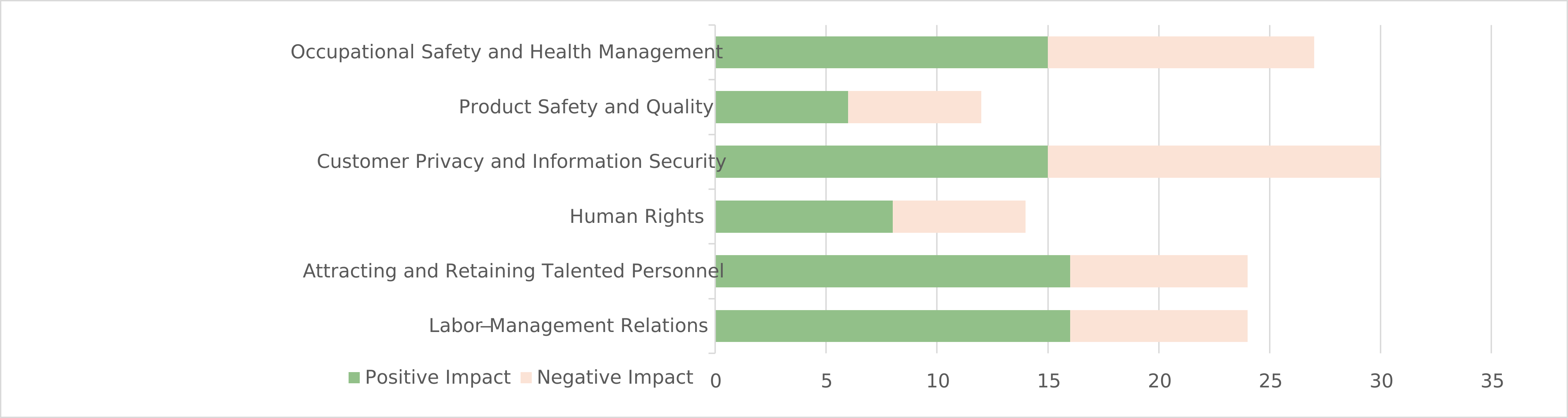
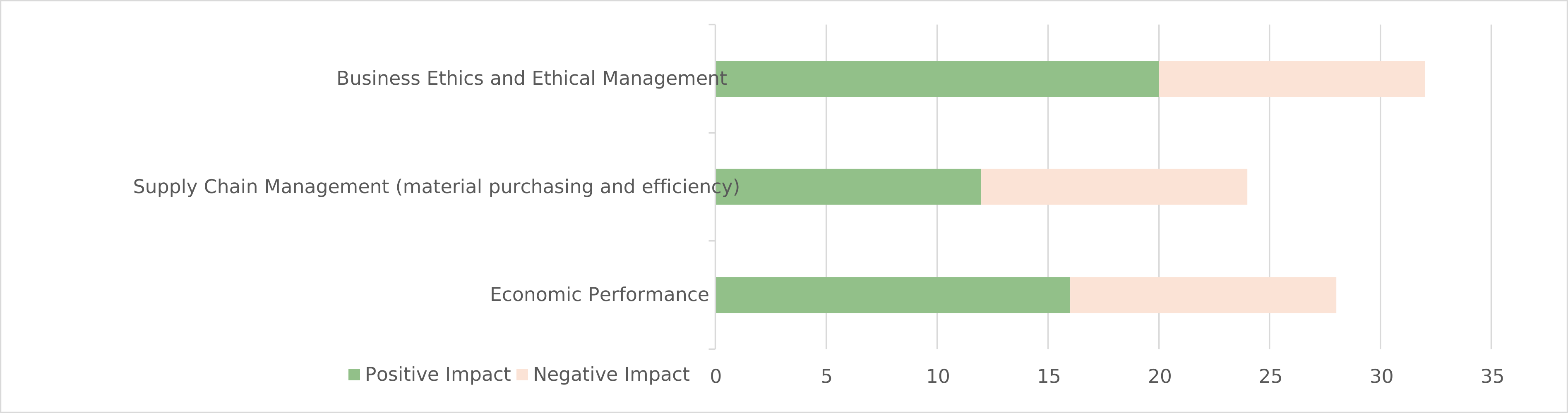
Ultimately, 14 material issues were selected, comprising 5 environmental issues (E), 6 social issues (S), and 3 corporate governance issues (G).
|
Environment (E) |
Social (S) |
Corporate Governance (G) |
|
E-3 Waste and Hazardous Substance Management E-1 Air Pollution Management/Air Quality E-5 Climate Change (including carbon emissions management) E-6 Energy Management (including the use of renewable energy) E-11 Sustainable Products (including product development and the introduction of environmentally friendly materials into production) |
S-1 Occupational Safety and Health Management S-11 Product Safety and Quality S-9 Customer Privacy and Information Security S-8 Human Rights S-2 Attracting and Retaining Talented Personnel S-6 Labor–Management Relations |
G-1 Business Ethics and Ethical Management G-5 Supply Chain Management (material purchasing and efficiency) G-6 Economic Performance |
The Corporate Sustainable Development Committee assessed the economic, environmental, and social impacts of the 14 material issues, then comprehensively evaluated and summarized the issues’ actual/potential and positive/negative degrees of impact and probability of occurrence
|
Environment (E) |
|
|
Social (S) |
|
|
Corporate Governance (G) |
|
n Conduct regular reviews of material issues
EMC’s sustainability issues are identified and confirmed through internal impact assessments, comprehensive consideration of stakeholders’ opinions, and other relevant procedures, and are approved and finalized by the Corporate Sustainable Development Committee’s top responsible person. EMC continues to interact with stakeholders on a regular and irregular basis to monitor the Company’s positive and negative impacts and understand the expectations of internal and external stakeholders. Moreover, the Company conducts materiality identification on a yearly basis to comprehensively integrate internal and external perspectives and summarize them into material topics.
EMC has formulated management guidelines and developed action plans for its material topics, and it has established goals and metrics through data-based measurement strategies to regularly track implementation outcomes. As for other non-material topics, EMC has followed the existing management procedures and measures to disclose related indicators for stakeholders to understand EMC’s overall sustainability achievements.
Eventually, in 2024, EMC identified 14 material issues from 37 sustainability issues. The Corporate Sustainable Development Committee further confirmed the 14 material issues as the material topics for 2024, including 5 environmental (E) issues, 6 social (including human rights) (S) issues, and 3 governance (G) issues. The management methods for the material issues are described in corresponding chapters. The GRI indexes and related contents are listed in the Report's appendixes.
Environmental dimension: The five material topics are the same as those identified in 2023. In addition to the issues of Air Pollution and Waste Management, Energy Management, and Climate Change under the environmental management section that continuously attract stakeholders’ concern, it is hoped that other sustainable product and environmental sustainability issues, besides halogen-free environmentally friendly materials, can be considered in the process of higher-end products development.
Social (including human rights) dimension: In addition to the four topics identified in 2023, Product Safety and Quality and Human Rights have been added. There are issues that cannot be ignored, as human rights issues may lead to labor disputes, strikes, or demonstrations, and cause operational interruptions and economic losses to a company.
Governance dimension: The three material topics are the same as those from 2023.
|
Dimension |
Material Topic |
Actual and potential impacts on the economy, the environment, and people (human rights) |
||
|
Positive impact on EMC |
Negative impact on EMC |
|||
|
Environment |
Air Pollution Management/Air Quality |
EMC is committed to replacing the heavy oil used in its operational processes with natural gas in an effort to control pollution, reduce energy and resource consumption, and facilitate the development of a circular economy. |
In recent years, governments across Asia have tightened VOCs emission standards. Failure to upgrade existing equipment and management approaches in a timely manner will result in the following consequences: Fines and administrative sanctions (short-term costs) Production line shutdowns or production restriction orders (revenue will be affected) Failure to properly control the issues will lead to risks such as public complaints, deterioration of community relations, and penalties. |
|
|
Waste and Hazardous Substance Management |
Minimize environmental impacts and disposal costs to create resource recycling value. |
If unqualified waste disposal service providers are contracted and they engage in illegal dumping or improper waste disposal, then in accordance with China’s Solid Waste Law and Taiwan’s Waste Disposal Act, the parent company shall bear joint responsibility, and may face huge fines and criminal liabilities, thereby causing reputational damage to the Company. |
||
|
Hazardous Substance Management EMC is currently the world's largest manufacturer of halogen-free environmentally friendly substrates. This product is mainly used in high-end HDI boards, with a global market share of about 30%. Currently, about half of its revenue comes from halogen-free products. |
||||
|
Climate Change (including carbon emissions management) |
By inventorying the greenhouse gas emissions produced by operational processes, the Company can assess opportunities for cost reduction and effective emission mitigation and set corresponding objectives. External communication is also conducted to grasp the achievement status of adopted actions and objectives. |
The Company may be ousted from the market or face climate disaster risks due to lack of proactive actions. |
||
|
Energy Management (including the use of renewable energy) |
Energy remains a necessary condition and cost for an enterprise to manufacture products and operate. Enterprises have no control over the price of purchased energy, government energy policies, or the international energy supply, but they can improve the effectiveness of their internal energy use and relevant management. |
|||
|
Sustainable Products (including product development and the introduction of environmentally friendly materials into production) |
EMC not only continues to develop materials for high-end applications, but also upholds its social responsibility by focusing development on the adoption of halogen-free environmentally friendly materials, thereby reducing the impact of materials on the environment. |
--- |
||
|
Social |
Occupational Safety and Health Management |
Maintaining workplace safety & health and developing employee health management programs are EMC’s first-line guarantee for employees |
Long-term high-level risk exposure coupled with poor workplace safety management will lead to higher employee turnover and difficulty in employee recruitment. This will have a direct impact on a labor intensive manufacturer like EMC where production lines must operate smoothly for the Company to survive. Actual impact: Occupational accidents |
|
|
Human Rights |
To fulfill its responsibility to respect and protect human rights, the Company discloses its human rights protection spirit and basic principles, and treats all salaried employees (including permanent employees, contract employees, etc.) and disadvantaged workers (such as people with disabilities) with dignity and respect. The Company commits to take all necessary measures to prevent forced labor. |
Human rights issues may lead to labor disputes, strikes, or demonstrations and result in operational interruptions and economic losses for the Company. Human rights violation involving employees or customers will reduce employee and customer satisfaction, which will in turn affect workforce output and employees’ desire to stay. Moreover, it will reduce employees’ commitment to the organization, place the organization at risk of litigation, and damage the organization’s image and reputation. |
||
|
Attracting and Retaining Talented Personnel |
Long-term talent development is the Company’s ultimate goal. Talent will be cultivated from scratch, with sound support mechanisms and cultivation plans to accelerate the vision and development. |
The departure of skilled individuals will likely decrease morale, hinder work performance, and generate direct costs associated with recruitment and training as well as indirect costs from the difficulty in filling job vacancies. Because employee training is a strategic long-term investment, if the outcome of training is uncertain, it could lead to wasted resources. |
||
|
Labor–Management Relations |
Employees are EMC’s most important partners. In addition to protecting employees’ work rights and providing competitive compensation, the Company also shows great respect and care for employees, hoping to attract more outstanding talents. |
Improper handling of labor disputes will affect production stability and the Company’s reputation. |
||
|
Customer Privacy and Information Security |
In recent years, companies have faced hackers’ attacks, widespread cyber security threats, and product security issues, reinforcing the importance of enterprise information security. Therefore, business management has become increasingly focused on risk control and reduction, disaster recovery, and loss minimization. |
Inadequate and insufficient protection of information security and personal data can negatively impact business operations in many ways, including leakage of confidential information, damage to reputation, loss of customers, and legal risks. |
||
|
Product Safety and Quality |
Good quality ensures satisfied customers. Improved quality will facilitate product repositioning, potentially increase market share, reduce failure costs and sales costs, and increase the Company’s profits. |
Poor product or service quality will lead to lost business opportunities, reduced market share, product liability claims and loss of goodwill, reduced corporate productivity, and increased costs for improvement and repair. |
||
|
Corporate Governance |
Business Ethics and Ethical Management |
EMC incorporates stability, honesty, and integrity into business operations; establishes a sound corporate governance structure; and promotes relevant measures to protect the rights and interests of all stakeholders. Moreover, the Company assists the Board of Directors in carrying out its ethical management commitment by supervising the Company’s internal management and business activities to ensure that they comply with ethical management standards and that all business activities have a positive economic influence. |
A material breach of law will affect the Company’s reputation and brand image, which may in turn lower the Company’s market value and result in expenses due to fines. |
|
|
Supplier Management |
EMC has standardized its supply chain management procedures; established supplier management procedures; and incorporated labor rights, environmental protection, and safety and health management into the assessment and audit criteria for suppliers. Based on the assessment results, improvement measures are formulated to assist suppliers in continuous improvement, with an aim to improve sustainable management of the supply chain, reduce the supply chain’s operational risks, and establish partnerships with suppliers for sustainable development. |
Poor supply chain management may result in poor quality or delayed product delivery from suppliers, which in turn may affect the Company’s shipments and services. Supply chain risks can lead to production disruptions, cost increases, quality degradation, loss of reputation, and other problems. Weak supply chain management combined with sharply increased prices of raw materials such as copper foil, epoxy resin, and glass-fiber cloth will directly lead to the squeezing of EMC’s gross margin. |
||
|
Economic Performance |
Maintaining stable financial performance is EMC’s commitment to stakeholders. |
Poor corporate governance may lead to internal corruption and misconduct, erode investor confidence impact shareholders’ interests, and damage the Company’s image and reputation. |
||
Contact
|
Tittle |
Tittle |
|
|
Investors |
Investor Relations |
ir@mail.emctw.com |
|
Regulatory authorities |
Head of Corporate Governance |
gov@mail.emctw.com |
|
Customers |
Head of marketing division |
sales@mail.emctw.com |
|
Vendors |
Head of Corporate Governance |
gov@mail.emctw.com |
|
Employees |
Head of Human resources division |
hr-emc@mail.emctw.com |
|
Community |
Head of Corporate Governance |
gov@mail.emctw.com |